Protecting What Keeps Society Running: A Practical Approach to Critical Information Infrastructure Protection


Modern societies run on invisible systems. Electricity grids, financial clearinghouses, emergency services, healthcare networks, transportation systems, and digital government platforms all depend on complex, interconnected information infrastructures. When these systems fail—whether due to cyberattacks, technical errors, or cascading dependencies—the impact is not merely technical. It is societal.
This is the domain of Critical Information Infrastructure (CII), and protecting it is no longer optional.
Key takeaways
- CII is defined by impact, not by technology.
- NIS2 raises the bar: stronger governance, risk management, and incident reporting.
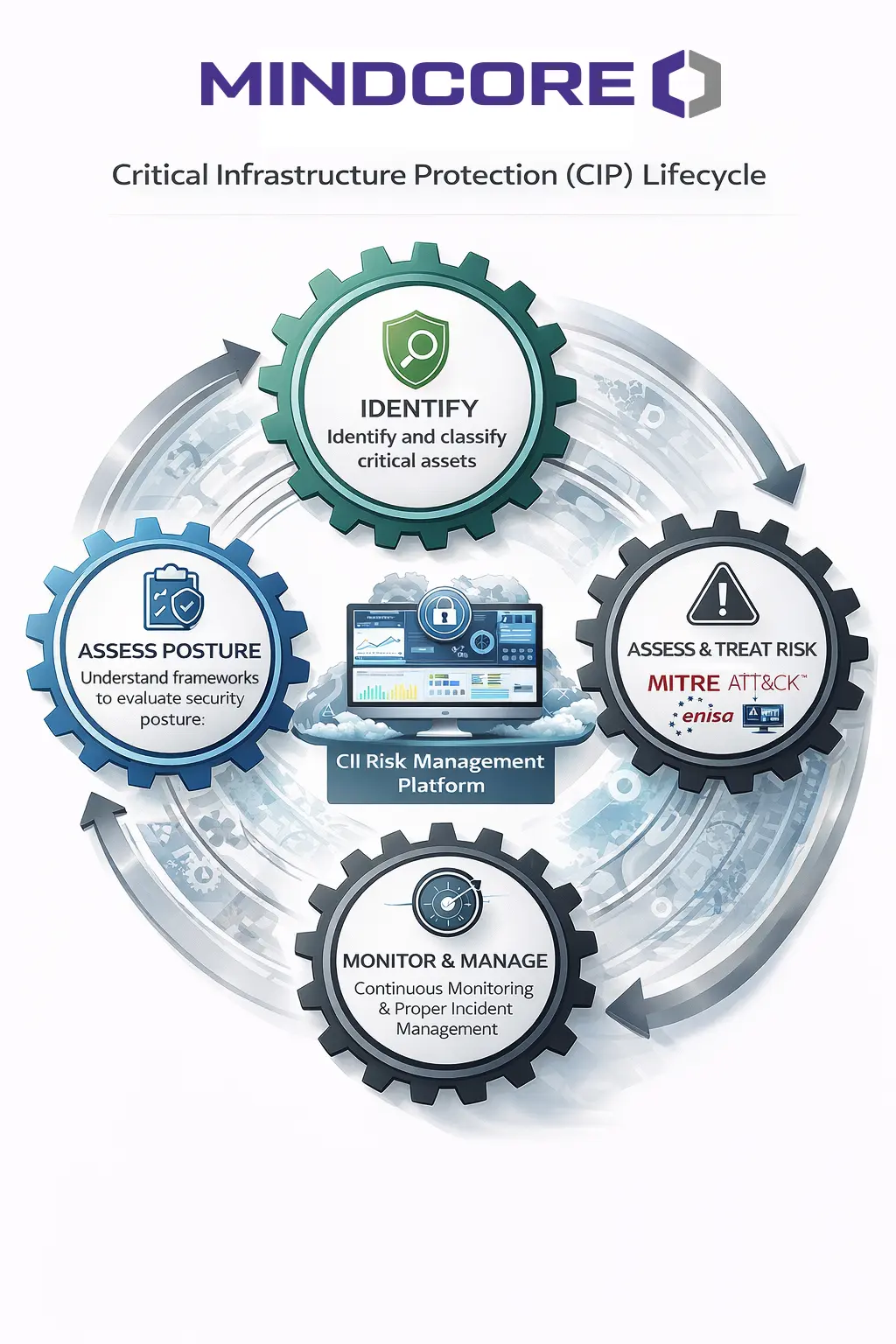
- Mindcore’s CIP lifecycle: Identify → Assess Posture → Assess & Treat Risk → Monitor & Manage → Incident Readiness.
- Threat-informed risk improves decisions: scenarios are mapped using MITRE ATT&CK and the ENISA threat taxonomy, supported by our CII Risk Management platform.
What are Critical Information Infrastructures?
Critical Information Infrastructures are the information systems, networks, and digital assets that underpin essential services—those whose disruption would have a significant impact on public safety, economic stability, national security, or public trust.
European directives define these infrastructures not by technology alone, but by impact. A service becomes critical when:
- it supports vital societal or economic functions
- it depends on IT and/or OT systems
- disruption would cause significant harm due to scale, duration, or interdependencies
This perspective is essential. Criticality is not about “important systems,” but about consequences.
Real-world incidents—from Stuxnet and the Ukrainian power grid attacks to healthcare ransomware cases and large-scale cloud outages—have repeatedly demonstrated that cyber incidents in CII environments translate directly into physical, economic, and human harm.
NIS2: From awareness to accountability
The EU’s NIS2 Directive (EU 2022/2555) marks a clear shift in how critical infrastructure protection is approached.
NIS2:
- expands the scope to more sectors and entities
- introduces stricter requirements for cyber risk management
- formalizes incident notification timelines (24h / 72h / 1 month)
- strengthens supervisory and sanctioning powers
- emphasizes supply-chain and dependency risk
But the most important shift is conceptual: cybersecurity is treated as a governance and risk management issue, not a purely technical one. NIS2 does not prescribe specific tools. Instead, it requires organizations to demonstrate that they understand their risks, manage them proportionately, and can detect, respond to, and recover from incidents.
Mindcore’s approach to Critical Infrastructure Protection
At Mindcore, we approach CIP as a continuous risk management lifecycle, rather than as a checklist exercise. While our work aligns naturally with directives such as NIS2, our starting point is always operational reality.
1) Identify: You can’t protect what you don’t know
The most common failure observed in CII programs is premature control implementation—deploying security measures without a clear understanding of what is actually critical.
Our first step aligns with the Identify function of the NIST Cybersecurity Framework and focuses on establishing a defensible scope. This includes identifying essential services and their operators, mapping the supporting IT, OT, and ICS/SCADA environments, and understanding how these systems interact.
Criticality is assessed using objective criteria such as the number of users affected, frequency of use, replaceability of the service, interdependencies with other essential services, maximum tolerable downtime, and potential impact on life, health, and the economy. Particular attention is given to IT/OT dependency levels, which are often underestimated but play a decisive role in real-world incidents.
Without this foundation, security investments risk being misaligned or ineffective.
2) Assess posture: Controls as evidence, not decoration
Once CII assets and services are identified, the next step is to understand how well they are currently protected. This is achieved by assessing the organization’s cybersecurity posture using established control frameworks that provide both structure and comparability.
At Mindcore, we rely on the NIST Cybersecurity Framework (CSF) to ensure functional coverage across Identify, Protect, Detect, Respond, and Recover, and on CIS Critical Security Controls v8 to translate those functions into concrete, prioritized technical and organizational measures.
The objective of this assessment is not to produce a maturity score for its own sake, but to develop an evidence-based understanding of the current state. This includes identifying which risks are already adequately addressed, where controls are partially implemented or inconsistently applied, and where gaps could expose critical services to unacceptable levels of risk.
The resulting posture assessment establishes a reliable baseline that directly informs risk analysis and decision-making.
3) Assess risk and treat it explicitly (threat-informed)
With assets, dependencies, and control posture clearly understood, the focus shifts to risk assessment and treatment. This phase follows recognized methodologies such as NIST SP 800-30, ISO/IEC 27005, or applicable national frameworks, ensuring consistency with regulatory and industry expectations.
Risk is evaluated as the combination of credible threats, exploitable vulnerabilities, and realistic impact on critical services. To make this assessment operationally meaningful, Mindcore applies a threat-informed approach that integrates real-world adversary behavior into the analysis.
This includes mapping potential attack scenarios using MITRE ATT&CK, providing visibility into adversary techniques and paths to impact, and aligning those scenarios with the ENISA threat taxonomy to ensure consistent categorization and regulator-aligned reporting. This approach enables stakeholders to discuss risk in a shared language, connect abstract risks to concrete attack patterns, and prioritize mitigations that measurably reduce exposure.
Based on this analysis, risk treatment decisions are made explicitly and transparently. Risks may be mitigated through technical or organizational controls, accepted with informed management approval, transferred where appropriate, or avoided altogether through architectural or operational changes. Clear ownership and governance are essential at this stage, ensuring that decisions are documented, reviewed, and revisited as conditions evolve.
Our CII Risk Management platform supports this lifecycle end-to-end, from asset and service inventories to threat-informed scenarios, risk registers, treatment plans, and continuous tracking over time.
4) Monitor continuously: Risk is not static
Critical Information Infrastructure operates in a constantly changing environment. Threat actors adapt their techniques, technologies evolve, dependencies grow more complex, and societal reliance on digital services continues to increase.
For this reason, effective CIP cannot rely on point-in-time assessments alone. Continuous monitoring is required to maintain an accurate understanding of risk. This includes ongoing visibility into security telemetry, vulnerability and exposure management, integration of threat intelligence, and regular reassessment following material changes or security events.
By treating risk as a dynamic condition rather than a static score, organizations are better positioned to anticipate emerging issues and adjust their controls before disruptions occur.
5) Prepare for and manage incidents
Incidents are not hypothetical scenarios in CII environments; they are an operational reality. The NIS2 Directive reinforces this by establishing clear expectations for incident notification, response coordination, and post-incident analysis.
At Mindcore, incident management is treated as a core resilience capability. This includes clearly defined CSIRT structures and responsibilities, well-documented and tested incident response plans, forensic readiness, and regular exercises that validate both technical and organizational preparedness.
Equally important is the feedback loop that follows an incident. Lessons learned are systematically incorporated into controls, detection capabilities, and risk models, strengthening the organization’s overall resilience and reducing the likelihood or impact of future events.
Detection without response creates noise. Response without preparation creates uncertainty.
Compliance is necessary—but never sufficient
Frameworks, directives, and standards provide an essential baseline. But compliance does not equal security.
True Critical Information Infrastructure Protection requires understanding what truly matters, prioritizing based on impact and dependency, treating cybersecurity as an ongoing risk management discipline, and fostering cooperation between authorities, operators, and technical partners.
CII protection is ultimately about societal resilience. When these systems fail, the consequences are shared by everyone.
That is why protecting them demands rigor, realism, and continuity—far beyond checkbox security.